Your Subcontractors Are Your Biggest Liability
Overview
WHAT EVERY HOMEBUILDER AND GENERAL CONTRACTOR NEEDS TO KNOW ABOUT SUBCONTRACTOR RISK
You can manage your team, your schedule, and your budget, but can you manage the risk of walking onto your jobsite under someone else’s name? For most homebuilders and general contractors, subcontractors represent the single greatest unmanaged liability exposure in their business. Not because subs are inherently dangerous, but because most GCs and builders have little visibility into what happens after they hand off the work, and even less protection if something goes wrong.
This whitepaper explores why subcontractor risk is so significant, where gaps most commonly appear, and how a structured pre-qualification and oversight program can protect your business, your reputation, and your bottom line.
The Hidden Exposure in Every Subcontract
You Own the Loss Even When You Didn’t Do the Work
When a subcontractor causes property damage or injuries a third party on your project, the injured party’s attorney names everyone, including the builder. As the party who hired and supervised the sub, you bear significant legal exposure regardless of who performed the work. Courts regularly find that a GC or builder exercised sufficient control over a job site to share liability for a subcontractor’s negligent work.
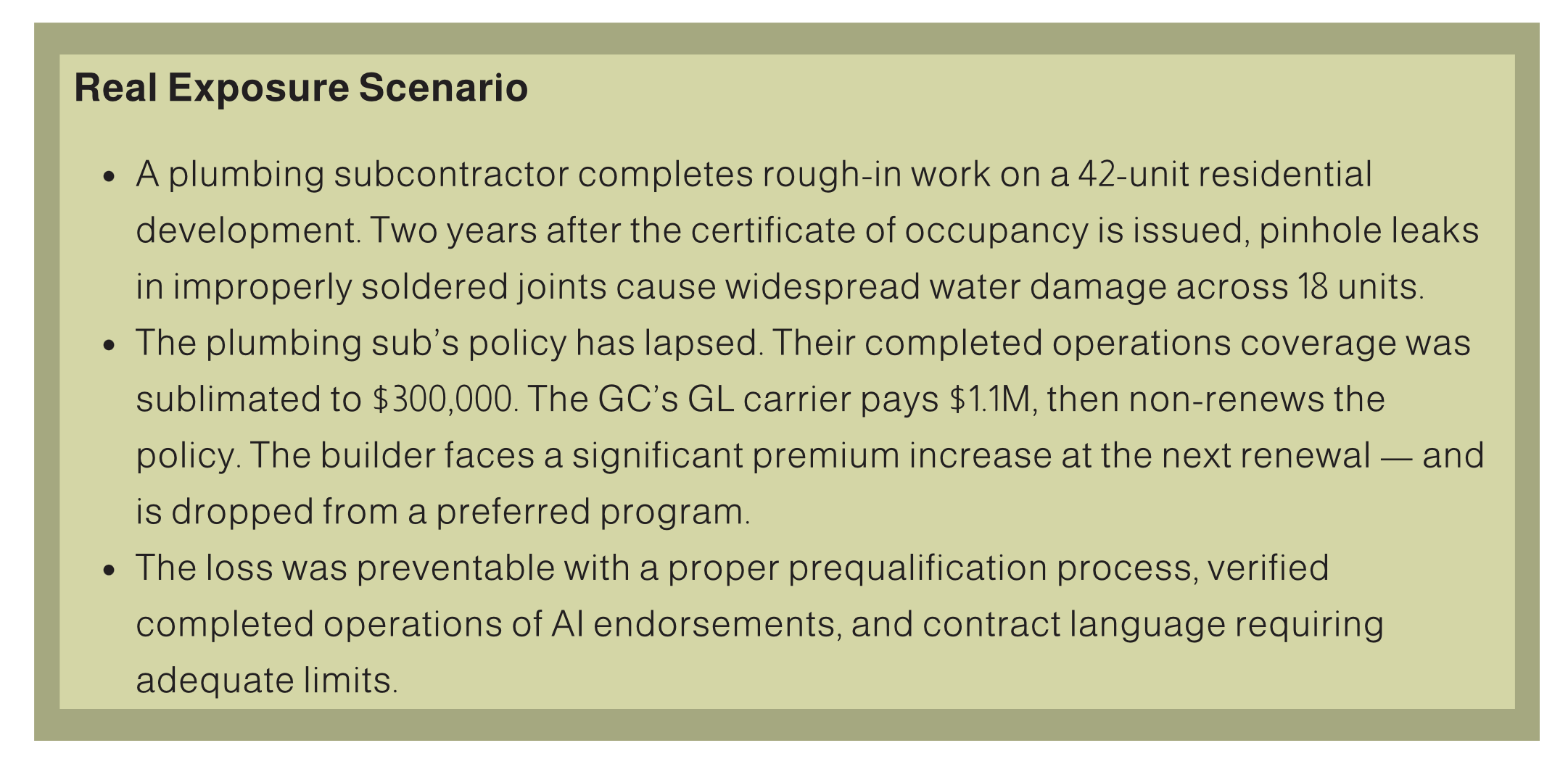
Completed operations claims are especially dangerous. A framing sub’s error may not manifest as water intrusion or structural movement for years. By then, the sub could be out of business, uninsured, or judgment-proof. You’re the one left standing, and paying.
The Insurance You Think Is There Often Isn’t
A certificate proves a policy existed the day it was issued, not that it's still active, or that it actually covers the work. Common gaps we see on subcontractor policies:
Completed operations coverage excluded or limited on lower-tier sub policies
Additional insured status covering ongoing work only, not completed operations
Minimum limits that get wiped out fast on a serious claim
Umbrella/excess policies that don't follow form, leaving a gap above the primary
Residential exclusions that void coverage for the exact job you hired them to do
A certificate tells you insurance existed. It doesn't tell you it'll actually pay when something goes wrong.
Where the Risk Lives: Five Critical Gaps
1. No Formal Pre-qualification Process
Most builders and GCs select subs based on price and relationship. Safety records, loss history, and financial stability rarely enter the conversation. A sub with a rising Experience Modification Rate or a history of serious claims is a materially different risk than one with a clean record — yet both may hand you the same certificate of insurance. A formal pre-qualification process can help reduce this exposure.
2. Contract Language That Doesn't Hold Up
Indemnification and hold harmless clauses are only as strong as the insurance behind them. Broad form indemnification that includes your own negligence is unenforceable in many states, including Oklahoma. And contracts that skip specific insurance requirements — limits, required endorsements, additional insured language, waiver of subrogation — leave you exposed even when you think you've transferred the risk.
3. Certificates Without Verification
Accepting a certificate at project start and filing it away isn't a risk management program. Additional insured status, completed operations coverage, and waivers of subrogation need to be confirmed on the actual endorsement — not assumed from the certificate. If a sub can't produce the required endorsement within 48 hours of request, they probably don't have one.
4. No Ongoing Monitoring
A sub who was qualified at project start can have a serious claim or coverage change mid-project, and without ongoing monitoring, you'd never know. Tracking certificate renewals and periodically re-verifying coverage is the minimum standard for any builder working with subs regularly.
5. Inadequate Subcontractor Safety and Insurance Requirements
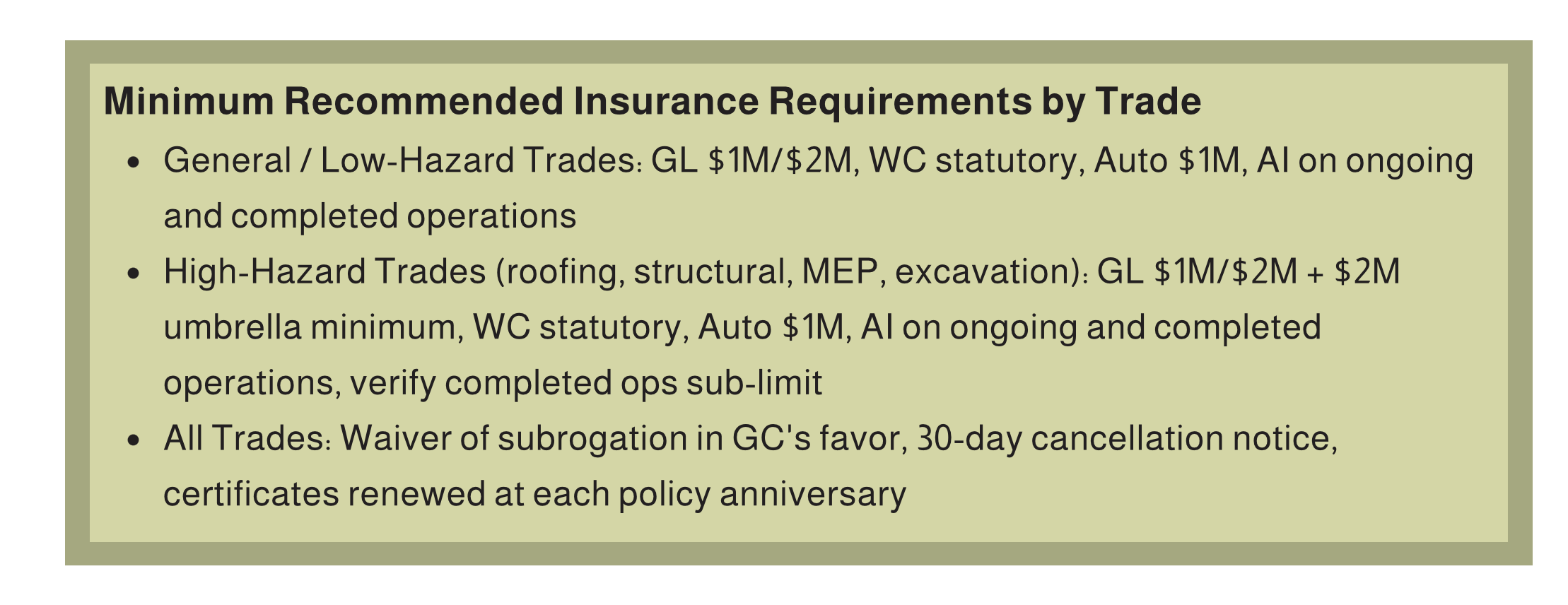
If you don't set minimum coverage and safety standards for subs, you're absorbing their risk as your own. Higher-hazard trades warrant higher limits, specific endorsements, and closer oversight. A tiered requirements framework lets you focus scrutiny where it matters most, without burying every vendor relationship in paperwork.
What a Strong Subcontractor Risk Program Looks Like
The good news: a structured approach to subcontractor risk doesn’t require a full-time risk manager or an enterprise compliance platform. It requires consistent execution of a few core practices — and the right partner to help you build and maintain them.
Pre-qualification Before You Hire
Before a sub begins work, document their loss history, confirm coverage meets your requirements, review their trade experience, and assess whether their safety practices fit your job site. This builds a defensible record of due diligence and helps you avoid the subs most likely to generate a claim.
Contracts That Actually Transfer Risk
Subcontract agreements should require specific limits tied to scope of work, mandate additional insured status on ongoing and completed operations, include a waiver of subrogation, and contain indemnification language enforceable in your state. Generic boilerplate rarely achieves this, and the gaps it leaves can be costly.
Certificate Management and Endorsement Verification
Collect certificates before work begins and renew them at each policy anniversary. Verify required endorsements on the actual policy documents, not the certificate. A simple tracking system for renewals and endorsements is one of the highest-return risk management investments a builder can make.
Tiered Requirements Based on Scope and Risk
A landscaping sub carries a different risk profile than a framing contractor or roofing crew, and your requirements should reflect that. One standard for every trade either under-protects high-hazard work or creates friction with low-risk vendors. A tiered approach solves both.
How Professional Insurors Helps You Choose the Right Subs
Subcontractor Pre-qualification Documents
We provide clients with professionally developed pre-qualification forms designed to surface the risk factors that matter most before a sub ever sets foot on your project.
Attorney-Ready Contract Templates
We provide model subcontract insurance language and indemnification provisions drafted for your state’s legal environment. These are designed for your attorney to review and approve, giving you a defensible, professional starting point rather than generic boilerplate.
Certificate Tracking and Endorsement Verification
We help you establish practical systems for collecting, tracking, and verifying subcontractor certificates including confirming that required endorsements appear on the policy, not just on the certificate.
Safety & Risk Management Intake
Through our structured intake process, we assess your current subcontractor oversight practices, identify gaps, and connect clients with deeper safety consulting resources when needed.
Market Access and Program Placement
A strong subcontractor management program is your best underwriting asset. We position our construction clients with carriers who recognize and reward documented risk management. This means better coverage, better terms, and better pricing at renewal.
Ongoing Advisory Support
Construction risk doesn’t sit still. From mid-term coverage questions to renewal strategy to contract review, our team is available year-round to help you make informed decisions.